

(SOLVED) Critical Thinking Community Cafe Discussion Post
Discussion Post Post your answer to 1 of the 3 questions with explanation and details. Please follow the Community Café Guidelines for participating in the Community Café. What is the […]
(SOLVED) The Heart
The human heart is a four-chambered hydraulic pump. A hydraulic pump uses differences in pressure to move material from areas of higher pressures to areas of lower pressures. The pressure […]
(SOLVED) The Blood – Hemophilia Discussion
Scenario/Summary – Jessie was a typical 2-year-old who liked to try and spread his wings. He would run and fall throughout the house. On several occasions, with minor falls, a […]
(SOLVED) Statistical Reasoning for Health Sciences – Maths and Probability
Hugo averages 62 words per minute on a typing test with a standard deviation of 14.5 words per minute. Suppose Hugo’s words per minute on a typing test are normally distributed. Let X= the number of […]
(SOLVED) Statistical Reasoning for Health Sciences
Find the graph that matches the following hypothesis test. H0:p≥17.1, Ha:p<17.1
(SOLVED) Statistical Reasoning for Health Sciences
Kenneth, a competitor in cup stacking, claims that his average stacking time is 8.2 seconds. During a practice session, Kenneth has a sample stacking time mean of 7.8 seconds based on 11 trials. At the 4% significance level, […]
(SOLVED) Statistical Reasoning for Health Sciences
Which of the following relationships below are examples of Causation? Assume that all of the following have a strong correlation. Select all that apply: The taller a person is, the larger […]
(SOLVED) Statistical Reasoning for Health Sciences
The larger the number of cavities, the older the person. Identify the relation between number of cavities and age. Select the correct answer below: Number of cavities and age are […]
(SOLVED) Reflection on Learning in NR667- FNP Capstone Practicum and Intensive
Reflection on Learning in NR667- FNP Capstone Practicum and Intensive. Please use “I” instead of generalizing it and provide references within last five years- Describe how learning in this course helped […]
(SOLVED) Statistical Reasoning for Health Sciences
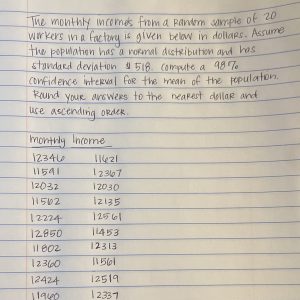
The monthly incomes from a Random sample of 20 workers in a factory is given below in dollars. Assume the population has a normal distribution and has standard deviation $518. […]
(SOLVED) Statistical Reasoning for Health Sciences
Assume that farm sizes in a particular region are normally distributed with a population standard deviation of 150 acres. A random sample of 50 farm sizes in this region is given below […]
(SOLVED) Statistical Reasoning for Health Sciences – Confidence Interval
Statistical Reasoning for Health Sciences Installation of a certain hardware takes a random amount of time with a standard deviation of 7 minutes. A computer technician installs this hardware on […]
(SOLVED) ATI Final Examination – With Answers
1. A nurse is preparing to administer an injection of an opioid medication to a client. the nurse draws out 1ml from a 2ml vile. which of the following actions […]
(SOLVED) NR 505 WEEK 3 Discussion Week 3: Collaboration Cafe Advanced Research Methods
NR 505 WEEK 3 Discussion Week 3: Collaboration Cafe Advanced Research Methods (Chamberlain University) With new information continually emerging, professional nurses must be equipped to critique scholarly literature and discern its value for practice. Select […]
(SOLVED) Nursing 172 Final Exam Period
Nursing 172 Final Exam Period What are the steps and concerns when D/C aPIV How do you prioritize what patient to see first? Know your scope of practice regular IV solution. IV complications and interventions I&O with the recommendation of what the patientneeds (more or less) Albumin administration and your assessment AHTR back/flank pain-hypotension-chills- dark/brick urine isotonic, hypotonic, and hypertonic solutions Dextrose-why do we administer it and […]
(SOLVED) Biology Questions with Answers. – Nursing Concepts
1. What are the prezygotic barriers? 2. What are the postzygotic barriers? 3. Describe habitat isolation in simple terms. 4. Describe temporal isolation in simple terms. 5. Describe behavioral isolation […]
(SOLVED) Nursing Windshield Survey
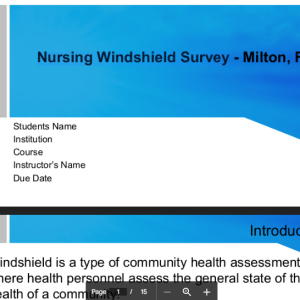
Windshield Survey and Grading Rubric Community health nurses often perform community Windshield Surveys by driving or walking through an area and making organized observations. The nurse can gain an understanding […]
(SOLVED) Basic Ideals and Principles of American Democracy and How They Are Applied In The United States
Subject The fundamental values that inform how are democratic government is legitimated and organized are enshrined on the Declaration of Independence and in the Constitution of the United States. Identify some of […]
(SOLVED) Leadership and Emergency Management
ubject Emergency Leadership Research Additional notes Research and choose two different articles on a man-made or natural disaster of your choice. Specifically choose articles for their emergency services administration and […]
(SOLVED) Addressing the Educational Needs of Nurses in Long-Term Care Through Refresher Training
Title of Paper Student Name Arkansas State University Course #, Title Instructor Name Date 2 Title of Paper You will provide a brief introduction over your paper. (This is your […]
(SOLVED) Comparison of Lewin’s Change Theory and Rogers’ Diffusion of Innovations Theory
Discussion Compare and contrast two change and/or nursing theories. Explain which theory would best support the implementation of your specific evidence-based intervention. Provide rationale for your choice. Gather feedback on […]
(SOLVED) Assess the culture of the clinical site/organization
DQ 1. Assess the culture of the clinical site/organization and organizational policies for potential challenges in implementing the nursing practice intervention. Why is understanding the health care system and clinical […]
(SOLVED) FNP Capstone Practicum and Intensive week 8 Reflection NR667
FNP Capstone Practicum and Intensive NR667 Purpose The purpose of this assignment is to provide the student an opportunity to reflect on learning in the course related to course outcomes, […]
(SOLVED) Learning Disability Attention-deficit/hyperactivity disorder (ADHD) Paper
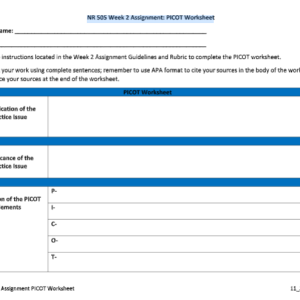
PROMPT: Paper should describe and explain learning disability ADHD. 1. Please include the signs, symptoms, and causes. 2.Statistical information about disorder. (How common, frequent, prevalent). 3. Methods of teaching that […]

(SOLVED) Global Health Organizations
Subject Global Health
Additional notes Post a response in which you:
1. Briefly describe a specific global health problem (e.g., malnutrition resulting from drought, infant mortality resulting from lack of family planning, or infectious disease resulting from deforestation) that is being addressed by at least one type of international organization (i.e., multilateral agencies, bilateral agencies, and NGOs).
2. Explain statistical measures associated with the health problem.
3. Analyze how local agencies are helping to address the health problem.
4. Analyze the work of one international agency that is helping to address the problem.
5. Analyze any international agreements that address the problem.
6. Explain how the problem requires interdisciplinary efforts.
Also put in-text citation, and at least 3 references include this:
Birn, A. E., Pillay, Y., & Holtz, T. H. (2017). Between international and global health: Contextualizing the present. In Textbook of global health (4th ed., pp. 43–88). Oxford University Press.
Birn, A. E., Pillay, Y., & Holtz, T. H. (2017). Global health actors and activities. In Textbook of global health (4th ed., pp. 141–192). Oxford University Press.
Birn, A. E., Pillay, Y., & Holtz, T. H. (2017). The historical origins of modern international (and global) health. In Textbook of global health (4th ed., pp. 1–42). Oxford University Press.
*WARNING!!! STRICTLY NO AI (0%) and 0% PLAGIARISM*
(SOLVED) ECO/535: The Digital Economy
Subject ECO/535: The Digital Economy Additional notes Exam Content Promoting international trade is not a zero-sum game. It is a win-win proposition; both parties gain from trade. Consider the following: […]
(SOLVED) Week 7 Virtual Lab: Introduction to Macromolecules Simulation – Part I Labster
Week 7 Virtual Lab: Introduction to Macromolecules Simulation – Part I Labster
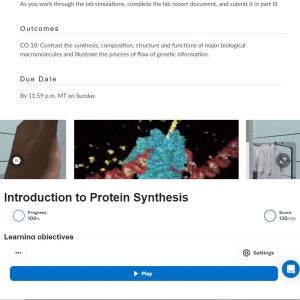
(SOLVED) Week 7 Virtual Lab: Protein Synthesis Simulation – Part II
Week 7
Virtual Lab: Protein Synthesis Simulation – Part II
Assignment
Instructions
Before starting the lab simulation, please download the lab report document from part I.
As you work through the lab simulations, complete the lab report document, and submit it in part III.
Outcomes
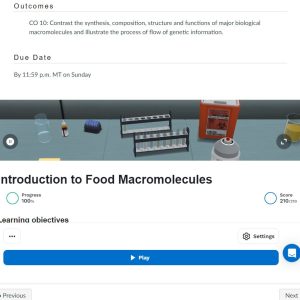
CO 10: Contrast the synthesis, composition, structure and functions of major biological macromolecules and Illustrate the process of flow of genetic information.
Due Date
(SOLVED) Week 7 Virtual Lab: Labster Lab Report Document Submission – Part III
Virtual Lab Week 7: Introduction to Food Macromolecules
Learning Objectives
• Understand the types of macromolecules found in food
• Understand the structure of carbohydrates, proteins, and lipids
• Detect macromolecules in food samples
Introduction
Macromolecules are very large molecules created by the polymerization of small units called monomers. Most of the macromolecules are present in everyday life, for instance in food.
Learn about biological macromolecules
There are several types of biological macromolecules: carbohydrates, proteins, lipids and nucleic acids. All macromolecules, except lipids, are polymers. A polymer is a long molecule composed of chains of monomers. Monomers are small molecules that serve as building blocks of polymers. In addition, there are also oligomers in nature. Oligomers are molecular complexes composed of a few monomer units, instead of the theoretical unlimited number of monomers. Dimers and trimers are oligomers composed of two and three monomers, respectively, such as lactose in milk for instance. However, in biochemistry, an oligomer usually refers to a macromolecular complex formed by non-covalent bonding of a few macromolecules, such as nucleic acids or proteins. An example is the oligomers found in many neurodegenerative diseases, such as the alpha-synuclein aggregations in Parkinson’s disease.
Help your friend with your macromolecule knowledge
In the Introduction to Food Macromolecules simulation, you will help your friend get a healthy diet and investigate the types of macromolecules found in food. By performing a series of biochemistry tests, you will know the contents of various food items.
Can you use your macromolecule knowledge to convince your friend to change her diet to a healthier one?
Study the transcription and translation processes
Begin by learning about the transcription process of DNA to RNA. Discover the translation process where an RNA sequence is read by a ribosome inside a cell and the corresponding to amino acids are made. With these two processes any protein can be made. How do the amino acids form different proteins?
Synthesis of proteins from amino acids
Find out how amino acids are assembled to make proteins. A 3D animation describes how triplets of codons in the RNA sequence are translated into amino acids. Observe how these amino acids are joined together by peptide bonds to create a polypeptide chain: this is the primary structure of a protein. Then watch as the primary structure is folded into secondary, tertiary and quaternary structures. Discover the two main types of secondary structure and see an example of how the tertiary structure of a protein can be modified post-translation.
Part 1: Complete Labster Lab: Introduction to Food Macromolecules
Purpose: Describe in complete sentences and in your own words, the purpose of this experiment.
Observations: Record three observations from the simulation.
Answer the questions below
1. Describe the key functions in the body of the biomolecules you studied in this virtual lab AND include key structural details.
a. Carbohydrates
b. Proteins
c. Lipids
2. Choose a food in your house. What are some of the biomolecules you expect to be in this food and why?
Part 2: Complete Labster Lab: Introduction to Protein Synthesis
3. In your own words, describe the process of gene expression beginning from the nucleus to the formation of the polypeptide sequence.
4. Complete the table below (2 points):
Nucleic acid Amine Bases Present Location(s) in cell
DNA
RNA
5. Assume that RNA Polymerase will read the parental strand of DNA given here and write the mRNA sequence that would result: – TATGCTTCCGTA –
Reflection: Consider what you learned from the two simulations. Reflect on three to four key concepts that you learned in this lab exercise. How could the lessons have learned in this virtual lab related to a real world situation in the community/world or your future career? Be specific in your answer (this should require 5-10 sentences).
Grading Rubric:
Activity Deliverable Points
Part I Complete Week 7 Virtual Lab: Introduction to Macromolecules Simulation 10
Part II Complete the Introduction to Protein Synthesis simulation 10
Part III Complete lab report and answer questions
• Purpose (1 point)
• Observation (3 points)
• Questions (6 points)
• Reflection (5 points) 15
Total Complete all lab activities 35
(SOLVED) statistical information in the media or popular press
For each of the three course topics listed below, find a relevant misrepresentation of statistical information in the media or popular press and answer the questions provided. Typically the source material will include a chart or table with accompanying text or a chart/table alone. Provide a photo or screen capture representing what you have chosen as well as the details (reference) to the source of the material. Note: there are a plethora of sources that have compiled examples as well as analyses of misleading statistics or charts – do not rely on these – you must find your own.
Data and Sources: Find a representation of statistics represented in the media or popular press that has an ambiguous, problematic or misleading sampling or data collection method or does not tell the “whole picture” with respect to the data.
What story are the authors trying to tell with these statistics (what is the apparent message)?
What is ambiguous, problematic or misleading with respect to the sampling or data collection?
What would the clear, accurate message be, based on what is there?
Communicating Data: Find an example of quantitative and/or quantitative data employed in the media or popular press that is presented in an ambiguous, problematic or misleading way.
What story are the authors trying to tell with these statistics (what is the apparent message)?
What is ambiguous, problematic or misleading with respect to the presentation of the qualitative/quantitative data? Note: your example must be specific to issues around qualitative/quantitative data.
What would the clear, accurate message be, based on what is there?
Relationships and Modelling: Find an example of a relationship between two variables or a “prediction” or modelling, based on the relationship between two variables employed in the media or popular press that is presented in an ambiguous, problematic or misleading way.
What story are the authors trying to tell with these statistics (what is the apparent message)?
What is ambiguous, problematic or misleading with respect to the presentation of the relationship or modelling? Note: your example must be specific to issues around relationships, predictions or modelling.
What would the clear, accurate message be, based on what is there?
(SOLVED) Virtual Lab: Lab Report Document Submission – Part III
Week 5Virtual Lab: Redox Simulation – Part I
Assignment
Instructions
Complete the simulation.
As you work through the lab simulations, complete the lab reportLinks to an external site.Links to an external site. document, and submit it in Part III.
Outcomes
CO 7: Predict the properties of and identify reduction and oxidation agents as well as acids and bases by analysis of chemical formulas, chemical reactions, and solution pH values.
Due Date
By 11:59 p.m. MT on Sunday
Week 5Virtual Lab: Organic Chemistry – Part II
Assignment
Instructions
This section contains no simulation and instead contains a link to help you complete your lab report; please download the lab report document from Part I. Complete the lab report document, and submit it in Part III.
To help you get started in the lab, please watch the video here on using the Moleview programLinks to an external site. before moving on to Part III.
Outcomes
CO 8: Differentiate the common classes of organic functional groups and identify the appropriate common or IUPAC names, applications, and chemical structures for simple organic.
Due Date
By 11:59 p.m. MT on Sunday
Week 5Virtual Lab: Lab Report Document Submission – Part III
Assignment
Instructions
Turn in your lab report document here after completing your lab simulations. Your lab report document is in part I.
Outcomes
CO 7: Predict the properties of and identify reduction and oxidation agents as well as acids and bases by analysis of chemical formulas, chemical reactions, and solution pH values.
CO 8: Differentiate the common classes of organic functional groups and identify the appropriate common or IUPAC names, applications, and chemical structures for simple organic.
Due Date
By 11:59 p.m. MT on Sunday
OL Lab 9: Building models of organic compounds
Learning Objectives:
Build virtual models to learn about the structure of organic compounds
Draw extended structural formulas of organic compounds
Compounds that are based on the carbon atom are known as organic compounds. These compounds commonly contain, nitrogen, oxygen, and hydrogen in addition to carbon. Carbon forms a variety of covalent compounds with varied properties. Carbon containing compounds are formed by sharing electrons, covalent bonds, between atoms. Most biomolecules, as well as most drugs, are classified as organic compounds. In this laboratory exercise, you will build models of organic compounds virtually and draw the extended structural formula of organic compounds.
Online Modeling Resource: http://molview.org/
Note: Be sure to build each of the compounds as instructed using the online modeling resource kit. This hands-on experience is an important part of this lab. You will need to copy the models you build in the virtual modeling resource and paste the images into this document. Please take the time to explore the structures of these organic compounds.
Exploration 1: Building models of Hydrocarbons
Hydrocarbons are a diverse group of organic compounds containing carbon and hydrogen. Hydrocarbons can be linear, branched, or cyclic. Additionally, hydrocarbons can be saturated, unsaturated or aromatic.
Using the virtual resource build the extended structural formulas of the following compounds. Copy and paste the images into the space below. Additionally, type in the condensed structural formula.
Propane
Virtual Model with Extended Structural Formula:
Condensed Structural Formula:
Butane
Virtual Model with Extended Structural Formula:
Condensed Structural Formula:
Ethylene
Virtual Model with Extended Structural Formula:
Condensed Structural Formula:
Ethyne
Virtual Model with Extended Structural Formula:
Condensed Structural Formula:
Propyne
Extended Structural Formula:
Condensed Structural Formula:
Ethane
Virtual Model with Extended Structural Formula:
Condensed Structural Formula:
Exploration 2: Identification of Functional Groups
Part 2A: Building functional groups
Functional groups alter the properties of hydrocarbons.
Using the virtual resource build the extended structural formulas of the following compounds. Copy and paste the images into the space below.
Alcohol
Ether
Ketone
Carboxylic acid
Aldehyde
Ester
Amine
Part 2B: Identification of functional groups:
Complete the table below by identifying the functional groups and names of the condensed structural formulas below.
Condensed Structural Formula
Name of Functional Group
Name of Organic Molecule
CH3CH2COCH3
CH3CH2CHO
CH3OH
CH3CH2CH2CH2CH2NH2
CH3CH2CH2COOH
Exploration 3: Building hydrocarbons containing functional groups
Using the virtual resource build the extended structural formulas of the following compounds. Copy and paste the images into the space below.
Difluoromethane
Virtual Model with Extended Structural Formula:
Trichloromethane
Virtual Model with Extended Structural Formula:
Tetrachloromethane
Virtual Model with Extended Structural Formula:
Propanol
Virtual Model with Extended Structural Formula:
Ethanoic Acid
Virtual Model with Extended Structural Formula:
Combine the propanol and the ethanoic acid from the last two exercises to make propyl ethanoate
Virtual Model with Extended Structural Formula:
Phenol
Virtual Model with Extended Structural Formula:
Dimethyl ether
Virtual Model with Extended Structural Formula:
Condensed Structural Formula:
Propanal
Virtual Model with Extended Structural Formula:
Condensed Structural Formula:
Hexanoic acid
Virtual Model with Extended Structural Formula:
Condensed Structural Formula:
Ethylamine
Virtual Model with Extended Structural Formula:
Condensed Structural Formula:
Questions:
Write the names of a biomolecule (also known as macromolecules) that contain each of the functional groups below.
Amine
Aldehyde
Carboxylic Acid
Alcohol
Find an example of an ester used as a fragrance or flavoring and give the name, condensed structural formula, and flavor of your chosen ester.
For each of the following, give the functional group and application
Formaldehyde
Ethanol
Acetone
Phenol
Reflection: Consider what you learned from this simulation. Reflect on three to four key concepts that you learned in this lab exercise. How could the lessons learned in this virtual lab relate to a real world situation in the community/world or your future career? Be specific in your answer (this should require 5-10 sentences).
Grading Rubric:
Activity
Deliverable
Points
Part I:
Redox Reactions: Discover how batteries work! Virtual Lab
7
Part II: Exploration 1:
Build/draw all hydrocarbons: 5 points
3
Part II: Exploration 2:
Build/draw all functional groups: 3.5 points and complete the table: 5 points.
8.5
Part II: Exploration 3:
Build/draw all organic molecules: 5.5 points,
5.5
Part II: End of lab questions
Complete all questions: 9 points total (Questions 1 and 3 are 4 points each, question 2 is 1 point)
9
Part II: Reflection
Write a 10-14 sentence laboratory reflection
2
All Lab Deliverables
Complete ALL explorations and reflection activities
35
(SOLVED) Week 5 Organic Chemistry Discussion
Week 5: Organic Chemistry
1818 unread replies.1818 replies.
Week 5
Organic Chemistry
Discussion
Required Resources
Read/review the following resources for this activity:
Textbook: Chapters 14 and 16
Weekly Concepts
Initial Post Instructions
The Discussions in this course are set up deepen your understanding of the material as you make real world connections and employ creative thinking. To get the most from these discussions, full engagement is expected on the part of the student. Be sure to stop by the discussion section frequently, not only to post, but to read the postings of your peers and instructor. Engaging with your peers and learning together is key to this experience. For you initial post, choose one of the options below:
Option 1:
A growing concern in agricultural and food chemistry is the presence of residues in food. We use many forms of organic chemicals in agriculture and food chemistry and there is growing concern as to how safe these materials are. Choose an organic chemical used in agricultural of food chemistry and report on the functional groups contained in your compound, the uses of the compound, and the safety of that compound. This research will require one or more
Option 2:
Choose a compound that is classified as an ether, aldehyde, ketone, ester, or alcohol, or amide. Report on important applications of this compound using at least one outside source. Next, write the condensed structural formula of a simple molecule with an ether, aldehyde, ketone, ester, or alcohol functional group for your peers to name (do not give away the answer!).
Follow-Up Post Instructions
Respond to at least one peer or the instructor. Further the dialogue by providing more information and clarification.
Possible follow-up topics:
Comment on one of your peer’s postings to discuss whether you believe the benefits of using their compound outweigh the risks.
Reply to the post of a peer whom has posted option 2 as their initial post and name the molecule provided. Be sure to walk us through all parts of the naming process, explaining each step.
Research a recently banned organic compound (banned in last year).
Writing Requirements
Minimum of 2 posts (1 initial & 1 follow-up)
Minimum of 2 sources cited (assigned readings/online lessons and an outside source)
APA format for in-text citations and list of references
Grading
This activity will be graded using the Discussion Grading Rubric. Please review the following link:
Discussion Guidelines
Course Outcomes
CO 8: Differentiate the common classes of organic functional groups and identify the appropriate common or IUPAC names, applications, and chemical structures for simple organic.
Due Date
Due Date for Initial Post: By 11:59 p.m. MT Recommended by Wednesday
Due Date for Follow-Up Posts: By 11:59 p.m. MT on Sunday
Posts must be on two separate days.
(SOLVED) Clinical Documentation SOAP VS DAP Notes
Students are to watch the video(s) and read about Data Assessment Plan (DAP) Notes and Subjective Objective Assessment Progress/Plan (SOAP) Notes. Links are below:
“SOAP Notes” YouTube video: Click
hereLinks to an external site.
“Social Workers: Easy way to write SOAP Notes” YouTube Video: Click
hereLinks to an external site.
“Clinical Documentation” by NASW: Click hereLinks to an external site..
2. After watching the YouTube Video on SOAP Notes and reading about Clinical Documentation from NASW, students are answer the following items:
Describe how SOAP notes and DAP notes compare to each other; similarities and differences.
Which format do you prefer and why?
What format does your agency use (SOAP, DAP, OTHER)? Attach blank copy of form that agency utilizes. (If actual document not available, a screenshot of blank document is acceptable.
Compare field placement agency format with that of another agency
Use the type of documentation preferred at your field placement to describe the Be sure to use terminology Common Terminology for DocumentationLinks to an external site.
3. Assignment requirements: Size 12 font, Times New Roman, double spaced.
4. Important to note that this assignment will help with completing Process Recordings.
https://www.youtube.com/watch?v=acnbP_TVhuo&feature=youtu.be
https://www.youtube.com/watch?v=9TZqTtbBVXc