
Assignment
Purpose
The iHuman assignments provide students with opportunities to experience clinical scenarios that are relevant to lesson content through Virtual Patient Encounters. iHuman is a highly interactive and dynamic way to enhance student learning.
Course Outcomes
This assignment enables the student to meet the following course outcomes:
- CO 1: Apply advanced practice nursing knowledge to collecting health history information and physical examination findings for various patient populations. (POs 1, 2)
- CO 2: Differentiate normal and abnormal health history and physical examination findings. (POs 1, 2)
- CO 3: Document health history and physical examination findings in a logical and organized sequence. (POs 1, 2)
- CO 5: Conduct focused and comprehensive health histories and examinations for various patient populations. (POs 1, 2)
Due Date
Students must complete the assigned iHuman Virtual Patient Encounter and submit required documentation by Sunday at 11:59 p.m. MT.
Students are expected to submit assignments by the time they are due. Assignments submitted after the due date and time will receive a deduction of 10% of the total points possible for that assignment for each day the assignment is late. Assignments will be accepted, with penalty as described, up to a maximum of three days late. After that point, a zero will be recorded for the assignment.
Total Points Possible
This assignment is worth 100 points.
Preparing the Assignment
Follow these guidelines when completing each component of the assignment. Contact your course faculty if you have questions.
Remember This
You will get FIVE attempts for this week’s iHuman Virtual Encounter case. For future weeks’ iHuman Virtual Encounter cases you will only get ONE attempt.
Multiple practice attempts allow students the opportunity to review feedback from i-Human including documentation. Feedback is to be used to guide improvement on subsequent attempts for the practice case. It is never acceptable for students to submit feedback verbatim (or almost verbatim) and/or documentation in the EHR. Copying – Using the work of others is a violation of CU’s Academic Integrity Policy. Violations will be fully investigated by faculty and administration.
General Instructions
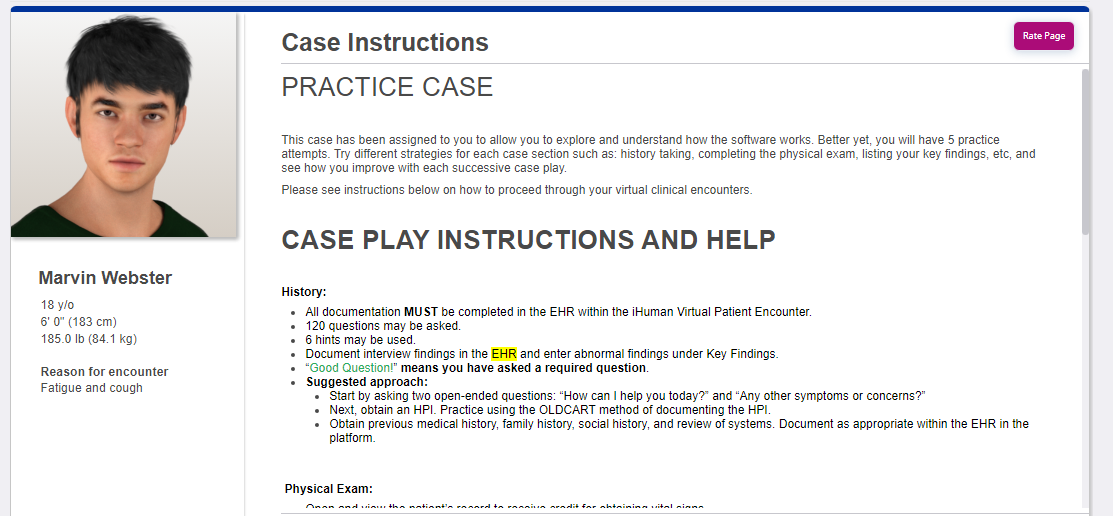
Throughout this course, you will have opportunities to engage with simulated patients using the iHuman virtual learning environment. For this assignment, you will complete the iHuman practice case and score your performance using the iHuman grading rubric. Completing the practice case and applying the grading rubric will help you learn to navigate the virtual simulation software, engage effectively and proficiently with a virtual patient, and understand grading expectations for iHuman assignments.
Open and review the grading rubric for the iHuman Virtual Patient Encounter. You may choose to download or print the rubric to use as a reference during your virtual encounter.
Access the iHuman practice case by clicking the link provided below. Clicking the blue bar will launch the activity in a new browser window. You do not need to complete the case in one sitting; if you leave the case and return later, the program will begin where you left off.
All graded documentation, including the Management Plan, must be completed within the iHuman platform. Follow the iHuman Documentation Guide and the grading rubric as you prepare your client’s EHR and management plan.
Include the following sections (detailed criteria listed below and in the grading rubric):
Complete the following components in the iHuman Virtual Patient Encounter for the practice case for Marvin F. Webster.
- Focused Health History
- Complete a focused health history. Scores are automatically calculated within the iHuman platform when the health history is submitted.
- Focused Physical Exam
- Complete a focused physical exam. Scores are automatically calculated within the iHuman platform when the health history is submitted.
- EHR Documentation (Subjective Data): Document the history of present illness (HPI) and focused review of systems (ROS). Documentation must be:
- accurate
- detailed
- written using professional terminology
- pertinent to the chief complaint
- includes subjective findings only
- EHR Documentation (Objective Data): Document physical exam findings. Documentation must be:
- accurate
- detailed
- written using professional terminology
- pertinent to the chief complaint
- include objective findings only
- Key Findings/Most Significant Active Problem: Document key findings from the history and physical exam in the Assessment tab of the case.
- Identify the most significant active problem (MSAP) and the relation of other key findings to the MSAP
- Problem Statement: Document a brief, accurate problem statement using professional language. Include the following components:
- name or initials, age
- chief complaint
- positive and negative subjective findings
- positive and negative objective findings
- Management Plan: Use the expert diagnosis provided to create a pertinent comprehensive evidence-based management plan. If a specific component of the management plan is not warranted (i.e., no referrals are appropriate for the virtual patient) document that no intervention is warranted. Include the following components:
- diagnostic tests
- medications: Type a specific prescription for each medication, including over-the-counter medications
- suggested consults/referrals
- client education
- follow-up, including time interval and specific symptomatology to prompt a sooner return
- Provide rationales for each intervention and cite at least one relevant scholarly source as defined by program expectations
- Click ”Submit” once the case is complete. Use this guide to download the Performance Overview ReportLinks to an external site..