(SOLVED) ECE-622 Research-Based Intervention and Remediation Strategies
May 3, 2024
ECE-622 Research-Based Intervention and Remediation Strategies
PLEASE ANSWER THE QUESTIONS BELOW.
Part 1: Applying Intervention and Remediation Strategies
With the students you identified previously, implement the literacy intervention and remediation activities you designed in “Clinical Field Experience C: Research-Based Intervention and Remediation Strategies.” You should meet with the students at least twice, once to conduct the intervention activity and again to conduct the remediation activity with them so they can improve in the skills deficit areas.
Part 2: Mentor Debriefing
After each of the two sessions in which you implement the intervention and remediation activities, meet with your mentor to discuss and take notes about the following. You will submit a copy of your feedback notes.
Obtain feedback on the effectiveness of your implementation of the literacy intervention and remediation activities.
Discuss the students’ responses to the activities and what was effective in helping students practice their literacy skills.
Identify potential areas for change or improvement in the literacy intervention and remediation activities based on the student response and outcomes.
Use any remaining field experience hours to provide support or assistance to the class as directed by your mentor.
In a reflection, addressing the following:
Describe the literacy skills deficits exhibited by the student and the intervention and remediation activities you developed to help them practice and improve their literacy skills.
Describe the results of implementing the literacy intervention and remediation activities with the students
Discuss the long-term results you would expect to see if you implemented these types of activities with the students over an extended period of time.
Reflect on your execution of the literacy intervention and remediation activities and their effectiveness. Include a discussion of both successes and challenges as well as changes you would make if implementing the activities again.
Submit the mentor debriefing notes and the reflection in a single document.
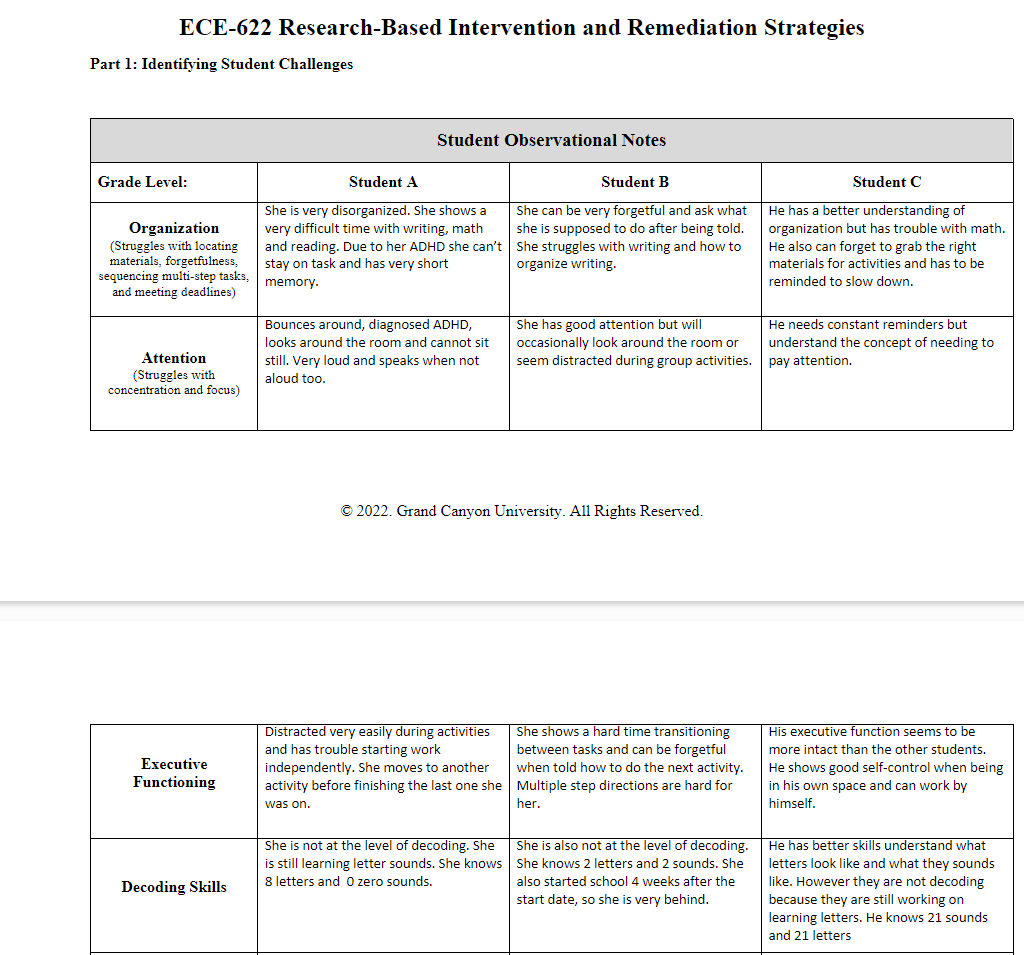
ECE-622 Research-Based Intervention and Remediation Strategies Part 1.: Identifying Student Challenges Student Observational Notes Grade Level: Organization [Struggles with locating materials, forgetfulnesa. sequencing multi-step tasks. and meeting deadlines] Student A She is very disorganized. She shows a very difficult time with writing. math and reading. Due to her ADHD she can’t stay on task and has very short memory. Student B She can be very forgetful and ask what she is supposed to do after being told. She struggles with writing and how to organize writing. Student C He has a better understanding of organization but has trouble with math. He also can forget to grab the right materials for activities and has to be reminded to slow down. Atte ntion [Struggles with c oncentratior. and focus) Bounces around, diagnosed ADHD, looks around the rooln and cannot sit still. Very loud and speaks when not aloud too. She has good attention but will occasionally look around the room or seem distracted during group activities. @1 2022. Grand Canyon University. All Rights Reserved. He needs constant reminders but understand the concept of needing to pay attention. Executive Functioning Decoding Skills Distracted very easily during activities and has trouble sta rting work independently. She moves to another activity before finishing the last one she was on. She is not at the level of decoding. She is still learning letter sounds. She knows 8 letters and 0 zero sounds. She shows a hard time transitioning between tasks and can be forgetful when told how to do the next activity. Multiple step directions are hard for her. She- is also not at the level of decoding. She knows 2 letters and 2 sounds. She also started school 4 weeks after the start date, so she is very behind. and 21 letters His executive function seems to be more intact than the other students. He shows good self-control when being in his own space and can work by himself. He has better skills understand what letters look like and what they sounds like. Howeverthey are not decoding because they are still working on learning letters. He knows 21 sounds