
Read patterns not scanned.pdf (ATTACHED) (8 pages), and answer the following questions:
1. What are the characteristics of well-established products such as paper, steel, and light bulbs?
2. What are the characteristics of “radical innovation new products” that require the re-orientation of
corporate goals?
3. What type of innovations are the hyper-loops and Falcon 9 rockets? Include your references.
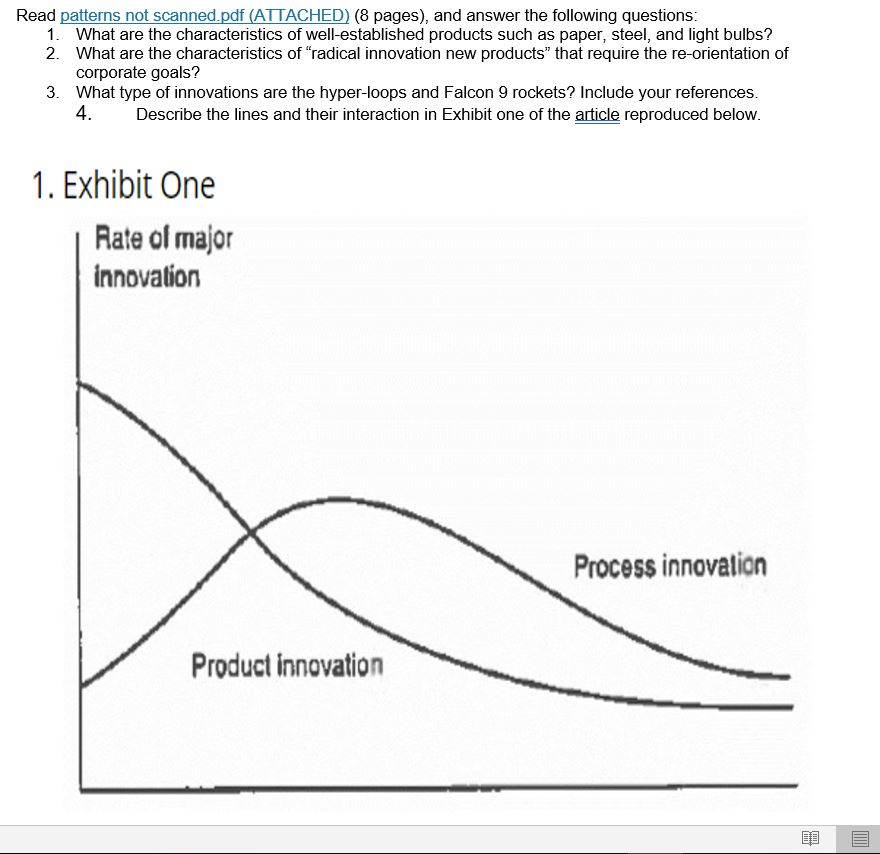
4. Describe the lines and their interaction in Exhibit one of the article reproduced below.
Patterns of Industrial
Innovation
William J. Abernathy and James M. Utterback
How do a company’s innovation and its response to
innovative ideas change as the company grows and
matures? Are there circumstances in which a pattern
generally associated with successful innovation is more
likely to be associated with failure? Under what
circumstances will newly available technology, rather
than the market, be the critical stimulus for a change!
When is concentration on incremental innovation and
productivity gains likely to be of maximum value to a
firm? In what situations does this strategy instead
cause instability and potential for crisis in an
organization?
Intrigued by questions such as these, we have examined
how the kinds of innovations attempted by productive
units change as these units evolve. Our goal was a
model relating patterns of innovation within a unit to
that unit’s competitive strategy, production
capabilities, and organizational characteristics.
This article summarizes our work and presents the basic
characteristics of the model to which it has led us. We
conclude that a productive unit’s capacity for and
methods of innovation depend critically on its stage of
evolution from a small technology-based enterprise to
a major high-volume producer. Many characteristics of
innovation and the innovative process correlate with
such a historical analysis and based on our model we
can now attempt answers to questions such as those
above.
A SPECTRUM OF INNOVATORS
Past studies of innovation imply that for any innovative
unit most of its innovations are new products. But that
observation masks an essential difference: what
constitutes a product innovation by a small,
technology-based unit is often the process equipment
adopted by a large unit to
improve its high-volume production of a standard
product. We argue that these two units-the small,
entrepreneurial organizations and the larger unit
producing standard products in high volume- are at
opposite ends of a spectrum. in a sense forming
boundary conditions in the evolution of a unit and the
character of its innovation of product and process
technologies.
One distinctive pattern of technological innovation is
evident in the case of established, high-volume
products such as incandescent light bulbs, paper, steel,
standard chemicals, and internal combustion engines,
as examples.
The markets for such goods are well defined; the
product characteristics arc well understood and often
standardized; unit profit margins are typically low;
production technology is efficient, equipment
intensive, and specialized primarily based on price.
Change is costly in such highly integrated systems
because an alteration in any one attribute or process
has ramifications for many others.
In this environment, innovation is typically incremental,
and it has a gradual, cumulative effect on productivity.
For example, Samuel Hollander has shown that more
than half of the reduction in the cost of producing
rayon in plants of E. I. du Pont de Nemours and
Company has been the result of gradual process
improvements which could not be identified as formal
projects or changes. A similar study by John Enos
shows that accumulating incremental developments in
petroleum refining processes resulted in productivity
gains which often eclipsed the gain from the original
innovation. Incremental innovations, such as the use of
larger railroad cars and unit trains, have resulted in
dramatic reductions in the cost of moving large
quantities of materials by rail. In all these examples,
major systems innovations have been followed by
countless minor product and systems improvements,
and the latter accounts for more than half of the total
ultimate economic gain due to their much greater
number. While cost reduction seems to have been the
major incentive for most of these innovations, major
Page 2
advances in performance have also resulted from such
small engineering and production adjustments.
Such incremental innovation typically results in an
increasingly specialized system in which economies of
scale in production and the development of mass
markets are extremely important. The productive unit
loses its flexibility, becoming increasingly dependent
on high-volume production to cover its fixed costs and
increasingly vulnerable to changing demand and
technical obsolescence.
Major new products do not seem to be consistent with
this pattern of incremental change. New products
which require a reorientation of corporate goals or
production facilities tend to originate outside
organizations devoted to a “specific” production
system; or. if originated within, to be rejected by them.
A more fluid pattern of product change is associated
with the identification of an emerging need or a new
way to meet an existing need; it is an entrepreneurial
act.
Many studies suggest that such new product
innovations share common traits. They occur in
disproportionate numbers in companies and units
located in or near affluent markets with strong science-
based universities or
other research institutions and entrepreneurially
oriented financial institutions. Their competitive
advantage over predecessor products is based on
superior functional performance rather than the lower
initial cost, and so these radical innovations tend to
offer higher unit profit margins.
When a major product innovation first appears,
performance criteria are typically vague and little
under- stood. Because they have a more intimate
understanding of performance requirements, users
may play a major role in suggesting the ultimate form
of the innovation as well as the need. For example,
Kenneth Knight shows that three-quarters of the
computer models that emerged between 1944 and
1950, usually those produced as one or two of a kind,
were developed by users.
It is reasonable that the diversity and uncertainty of
performance requirements for new products give an
ad- vantage in their innovation to small, adaptable
organizations with flexible technical approaches and
good external communications, and historical evidence
supports that hypothesis. For example, John Tilton
argues that new enterprises led in the application of
semiconductor technology, often transferring into
practice technology from more established firms and
laboratories. He argues that economies of scale have
not been of prime importance because products have
changed so rapidly that production technology
designed for a particular product is rapidly made
obsolete. And R. 0. Schlaifer and S.D. Heron has argued
that a diverse and responsive group of enterprises
struggling against established units to enter the
industry contributed greatly to the early advances in
jet aircraft engines.
A TRANSITION FROM RADICAL TO EVOLUTIONARY
INNOVATION
These two patterns of innovation may be taken to
represent extreme types-in one case involving an
incremental change to a rigid, efficient production
system specifically designed to produce a standardized
product, and the other case involving radical
innovation with product characteristics in flux. They
are not rigid, independent categories. Several
examples will make it clear that organizations currently
considered in the “specific” category-where
incremental innovation are now motivated by cost
reduction-were at their origin small, “fluid” unit’s
intent on new product innovation.
John Tilton’s study of developments in the
semiconductor industry from 1950 through 1968
indicates that the rate of major innovation has
decreased and that the type of innovation shifted.
Eight of the 13 product innovations he considers to
have been most important during that period occurred
within the first 7 years, while the industry was making
less than 5 percent of its total 18-year sales. Two types
of enterprise can be identified in this early period of
the new industry-established units that came into
semiconductors from vested positions in vacuum tube
Page 3
markets and new entries such as Fairchild
Semiconductor, IBM, and Texas Instruments, Inc. The
established units responded to competition from the
newcomers by emphasizing process innovations.
Meanwhile, the latter sought entry and strength
through product innovation. The three very successful
new entrants just listed were responsible for half of the
major product innovations and only one of the nine
process innovations which Dr. Tilton identified in those
18 years, while three principal established units
(divisions of General Electric, Philco, and RCA) made
only one-quarter of the product innovations but three
of the nine major process innovations in the same
period. In this case, process in- novation did not prove
to be an effective competitive stance; by 1966, the
three established units together held only 18 percent of
the market while the three new units held 42 percent.
Since 1968, however, the basis of competition in the
industry has changed; as costs and productivity have
become more important, the rate of major product
innovation has decreased, and effective process
innovation has become an important factor in
competitive success. For example, by 1973 Texas
Instruments, which had been a flexible new entrant in
the industry two decades earlier and had contributed
no major process innovations before 1968, was
planning a single machine that would produce 4 percent
of world requirements for its integrated-circuit unit.
Like the transistor in the electronics industry, the DC-3
stands out as a major change in the aircraft and airline
industries. Almarin Phillips has shown that the DC-3
was a cumulation of prior innovations. It was not the
largest or fastest, or longest-range aircraft it was the
most economical large, fast plane able to Oy long
distances. All the features which made this design so
completely successful had been introduced and proven
in prior aircraft. And the DC-3 was essentially the first
commercial product of an entering firm (the C1 and
DC-2 were produced by Douglas only in small
numbers).
Just as the transistor put the electronics industry on a
new plateau, so the DC-3 changed the character of
innovation in the aircraft industry for the next 15 years.
No major innovations were introduced into commercial
aircraft design from 1936 until new jet-powered
aircraft appeared in the 1950s. Instead, there were
simply many refinements to the DC-3 concept
stretching the design and adding appointments; and
during the period of these incremental changes, airline
operating cost per passenger-mile dropped an
additional 50 percent.
The electric light bulb also has a history of a long series
of evolutionary improvements which started with a
few major innovations; and ended in a highly
standardized commodity-like product. By 1909, the
initial tungsten filament and vacuum bulb innovations
were in place; from then until 1955 there came a series
of incremental changes- better metal alloys for the
filament, the use of “getters” to assist in exhausting
the bulb, coiling the filaments, ”frosting” the glass, and
many more. In the same period, the price of a 60-watt
bulb decreased (even with no inflation adjustment)
from S1.60 to 20 cents each, the lumens output
increased by 175 percent, and the direct labor content
was reduced by more than an order of magnitude,
from 3 to 0.18 minutes per bulb, and the pro- duction
process evolved from a flexible job shop configuration,
involving more than 11 separate operations and a
heavy reliance on the skills of manual labor, to a single
machine attended by a few workers.
Product and process evolved similarly to the automobile
industry. During a four-year trend period before Henry
Ford produced the renowned Model T, his company
developed, produced, and sold five engines, ranging
from two to six cylinders. These were made in a factory
that was flexibly organized much like a job shop.
relying on trade craftsmen working with general
purpose machine tools not nearly so advanced as the
best then available. Each engine tested a new concept.
Out of this experience came a dominant design-the
Model T; and within 15 years, 2 million engines of this
single basic design were being produced each year
(about 15 million all told) in a facility then recognized
as the most efficient and highly integrated in the
world. During those 15 years, there were incremental
but no fundamental innovations in the Ford product.
Page 4
In yet another case, Robert Buzzell and Robert Nourse.
tracing innovations in processed foods show new
products such as soluble coffees, frozen vegetables,
dry pet foods, cold breakfast cereals, canned foods,
and pre-cooked rice came first from individuals and
small organizations where research was in progress, or
which relied heavily upon information from users. As
each product won acceptance, its productive unit
increased in size and concentrated its innovation on
improving manufacturing. marketing, and distribution
methods which extended rather than replaced the
basic technologies. The major source of the latter ideas
is now each firm’s own research and development
organization.
The shift from radical to evolutionary product
innovation is a common thread in these examples. It is
related to the development of a dominant product
design. and it is accompanied by heightened price
competition and increased emphasis on process
innovation. Small-scale units that are flexible and
highly reliant on manual labor and craft skills utilizing
general-purpose equipment develop into units that
rely on automated equipment-intensive high-volume
processes. We conclude that changes in innovative
patterns, production process, scale, and kind of
production capacity all occur together in a consistent,
predictable way.
Though many observers emphasize new product in-
novation, process and incremental innovations may
have equal or even greater commercial importance. A
high rate of productivity improvement is associated
with process improvement in every case we have
studied. The cost of incandescent light bulbs. for
example, has fallen more than 80 percent since its
introduction. Airline operating costs were cut by half
through the development and improvement of the
DC3. Semiconductor prices have been falling by 20 to
30 percent with each doubling of cumulative
production. The introduction of the Model T Ford
resulted in a price reduction from $3,000 to less than
$1,000 (in 1958 dollars). Similar dramatic reductions
have been achieved in the costs of computer core
memory and television picture tubes.
MANAGING TECHNOLOGICAL INNOVATION
If it is true that the nature and goals of an industrial
unit’s innovations change as that unit matures from
pioneering to a large-scale producer, what does this
imply for the management of technology?
We believe that some significant managerial concepts
emerge from our analysis model. If you will, the
characteristics of innovation as production processes
and primary competitive issues differ. As a unit moves
toward large-scale production, the goals of its
innovations change from ill-defined and uncertain
targets to well-articulated design objectives. In the
early stages. there is a proliferation of product
performance requirements and design criteria that
frequently cannot be stated quantitatively. and their
relative importance or ranking may be quite unstable.
It is precisely under such conditions, where
performance requirements are ambiguous, that users
are most likely to produce innovation and where
manufacturers are least likely to do so. One way of
viewing regulatory constraints such as those governing
auto emissions or safety is that they add new
performance dimensions to be resolved by the
engineer- and so may lead to more innovative design
improvements. They are also likely to open market
opportunities for innovative change of the kind
characteristic of fluid enterprises in areas such as
instrumentation, components, process equipment, and
so on.
The stimulus for innovation changes as a unit matures.
In the initial fluid stage. market needs are ill-defined
and can be stated only with broad uncertainty. and the
relevant technologies are as yet little explored. So,
there are two sources of ambiguity about the
relevance of any particular program of research and
development – target uncertainty and technical
uncertainty. Confronted with both types of
uncertainty, the decision maker has little incentive for
major investments in formal research and
development.
As the enterprise develops. however. uncertainty about
markets and appropriate targets is reduced, and larger
research and development investments are justified. At
Page 5
some point before the increasing specialization of the
unit makes the cost of implementing technological
innovations prohibitively high and before increasing
cost competition erodes profit with which to fund large
indirect expenses, the benefits of research and
development efforts would reach a maximum.
Technological opportunities for improvements and
additions to existing product lines will then be clear,
and a strong commitment to research and
development will be characteristic of productive units
in the middle stages of development. Such firms will be
seen as “science-based” because they invest heavily in
formal research and engineering departments. with
emphasis on process; innovation and product
differentiation through functional improvements.
Although data on research and development
expenditures are not readily available based on
productive units, divisions, or lines of business, an
informal review of the activities of corporations with
large investments in research and development shows
that they tend to support business lines that fall
neither near the fluid nor the specific conditions but
are in the technologically active middle range. Such
productive units tend to be large, to be integrated, and
have a large share of their markets.
A small, fluid entrepreneurial unit requires general-
purpose process equipment which, typically, is
purchased. As it develops, such a unit is expected to
originate some process-equipment innovations for its
use; and when it is fully matured, its entire processes
are likely to have designed us integrated systems
specific to particular products. Since the mature firm is
now fully specialized, all its major process innovations
are likely to originate outside the unit.
But note that the supplier companies will now see
themselves as making product-not process
innovations. From a different perspective, George
Stigler finds stages of development-similar to those we
describe- in firms that supply production-process
equipment. They differ in the market structure they
face. in the specialization of their production
processes, and in the responsibilities they must accept
in innovating to satisfy their own needs for process
technology and materials.
The organization’s method of coordination and control
changes with the increasing standardization of its
products and production processes. As task uncertainty
confronts a productive unit early in its development,
the unit must emphasize its capacity to process
information by investing in vertical and lateral
information systems and liaison and project groups.
Later, they may be extended to the creation of formal
planning groups, organizational manifestations of
movement from a product-oriented to a transitional
state; controls for regulating process functions and
management controls such as job procedures, job
descriptions, and systems analyses are also extended
to become a more pervasive feature of the production
network.
As a productive unit achieves standardized products
and confronts only incremental change, one would
expect it to deal with complexity by reducing the need
for information processing. The level at which
technological change takes place helps to determine
the extent to which organizational dislocations take
place. Each of these hypotheses helps to explain the
firm’s impetus to divide into homogeneous productive
units as its products and process technology evolve.
The hypothesized changes in control and coordination
imply that the structure of the organization will also
change as it matures, becoming more formal and
having a greater number of levels of authority. The
evidence is strong that such structural change is a
characteristic of many enterprises and units within
them.
FOSTERING INNOVATION BY UNDERSTANDING
TRANSITION
Assuming the validity of this model for the development
of the innovative capacities of a productive unit, how
can it be applied to further our capacity for new
products and to improve our productivity?
We predict that units in different stages of evolution
will respond to different stimuli and undertake
Page 6
different types of innovation. This idea can readily be
extended to the question of barriers to innovation and
probably to patterns of success and failure in
innovation for units in different situations. The unmet
conditions for transition can be viewed as specific
barriers which must be overcome if a transition is to
take place.
We would expect new, fluid units to view as barriers
any factors that impede product standardization and
market aggregation, while firms in the opposite
category tend to rank uncertainty over government
regulation or vulnerability of existing investments as
more important disruptive factors. Those who would
promote innovation and productivity within U.S.
industry may find this suggestive.
We believe the most useful insights provided by the
model apply to production processes in which features
of the products can be varied. The most interesting
applications arc to situations where product innovation
is competitively important and difficult to manage; the
model helps to identify the full range of other issues
with which the firm is simultaneously confronted in a
period of growth and change. (See Exhibit 1.)
CONSISTENCY OF MANAGEMENT ACTION
Many examples of unsuccessful innovations point to a
common explanation of failure: certain conditions
necessary to support a sought-after technical advance
were not present. In such cases, our model may be
helpful because it describes conditions that normally
support advances at each stage of development;
accordingly, if we can compare existing conditions with
those prescribed by the model, we may discover how
to increase innovative success. For example, we may
ask the model such questions as these about different,
apparently independent, managerial actions:
• Can a firm increase the variety and diversity of
its product line while simultaneously realizing the
highest possible level of efficiency?
• Is a high rate of product innovation consistent
with an effort to substantially reduce costs through
extensive backward integration?
• Is government policy to maintain diversified
markets for technologically active industries a
consistent policy that seeks a high rate of effective
product innovation?
• Would a firm’s action to restructure its work
environment for employees so that tasks are more
challenging and less repetitive be compatible with a
policy of mechanization designed to reduce the need
for labor?
• Can the government stimulate productivity by
forcing a young industry to standardize its products
before a dominant design has been realized?
The model prompts an answer of no to each of these
questions; each question suggests actions that the
model tells us are mutually inconsistent. We believe
that as these ideas are further developed, they can be
equal to effectively helping to answer many far more
subtle questions about the environment for
innovation, productivity, and growth.
EXHIBIT 1 The Changing Character of Innovation and
Its Changing Role in Corporate Advance
Seeking to understand the variables that determine
successful strategies for Innovation, the authors
focus on three stages in the evolution of a successful
Page 7
enterprise: its period of flexibility, in which the
enterprise seeks to capitalize on Its advantages where
they offer the greatest advantages; its Intermediate
years, in which major products are used more widely;
and its full maturity, when prosperity Is assured by
leadership In several principal products and
technologies.
I
Competitive emphasis on
innovation stimulated by
The predominant type of
innovation
Product line
Production processes
Equipment
Materials
Plant
Organizational controls
Fluid pattern Transitional pattern Specific pattern
Functional product Product variation Cost reduction
performance information on
users, needs Opportunities created by Pressure to reduce cost and
and users, technical inputs expanding internal technical
capability
improve quality
Frequent major changes in
products
Major process changes
required by rising volume
incremental for product and
process, with cumulative
Improvement in productivity
and quality
Diverse, often Including
custom designs
includes at least one product
design stable enough to have
significant production
Mostly undifferentiated
standard products
Flexible and inefficient;
major changes easily
Becoming more rigid, with
changes occurring in major
Efficient, capital-intensive,
and rigid cost of change
General-purpose, requiring
highly skilled labor
Some subprocesses auto-
mated, creating,
Special purpose, mostly
automatic with labor tasks
inputs limited to generally Specialized materials Specialized materials de·
available materials perhaps demanded from manded; if not available,
extensive vertical integration
Small-scale, located near
user or source of
General-purpose with
Sections specialized
Large-scale, highly specific
to particular products
nformal and entrepreneurial Through liaison relationships,
projects, and task groups
Through emphasis on
structure, goals, and rulespatterns not scanned(2)_2MBA 603 Patterns of Innovation Assignment